


9 min read
Your collection holds more stories than your galleries can accommodate. For museums, galleries, and historical societies across New England and New York, the challenge is making more objects accessible while protecting them and preserving space for collections care.
Visible storage, is a trend that is changing how institutions approach this challenge. Museum visible storage strategies bring stored objects into public view, turning preservation areas into engaging, educational spaces. Donnegan Systems helps museums and historical societies across the region plan and install visible storage solutions tailored to each collection.
This article explores five visible storage solutions that help your institution display more of its collection while maintaining the preservation standards your artifacts require.
Key Takeaways: Visible Museum Storage
- Visible storage lets your museum showcase more of your collection that would otherwise remain hidden in staff-only storage areas.
- Storage as display reduces the need for separate exhibition and storage footprints, saving valuable square footage.
- Donnegan Systems designs storage solutions around your collection, building conditions, staff workflows, and goals for public engagement.
- Glass-fronted cabinets, drawer systems, mobile shelving, and art racks each address different collection types and access needs.
- Planning for preservation, security, and visitor access from the start ensures visible storage performs on every level.
What Is Visible Storage in Museums?
Blending storage and display can bring stored objects where the public can see them. Instead of reserving storage for staff-only back rooms, institutions integrate glass-fronted cabinets, open shelving, and display systems into galleries, lobbies, and dedicated visible storage rooms.
Visible storage is an established approach with regional examples. The Vermont Historical Society project combined art racks, cabinets with drawers and enclosed object displays with public access to collections information. The model brings collections care and public discovery into the same space.
For museums and historical societies in Massachusetts, Connecticut, Rhode Island, Vermont, New Hampshire, Maine, and New York, visible storage offers a practical planning option. When your building cannot expand, bringing stored objects into the visitor experience helps you do more with the space you already have.
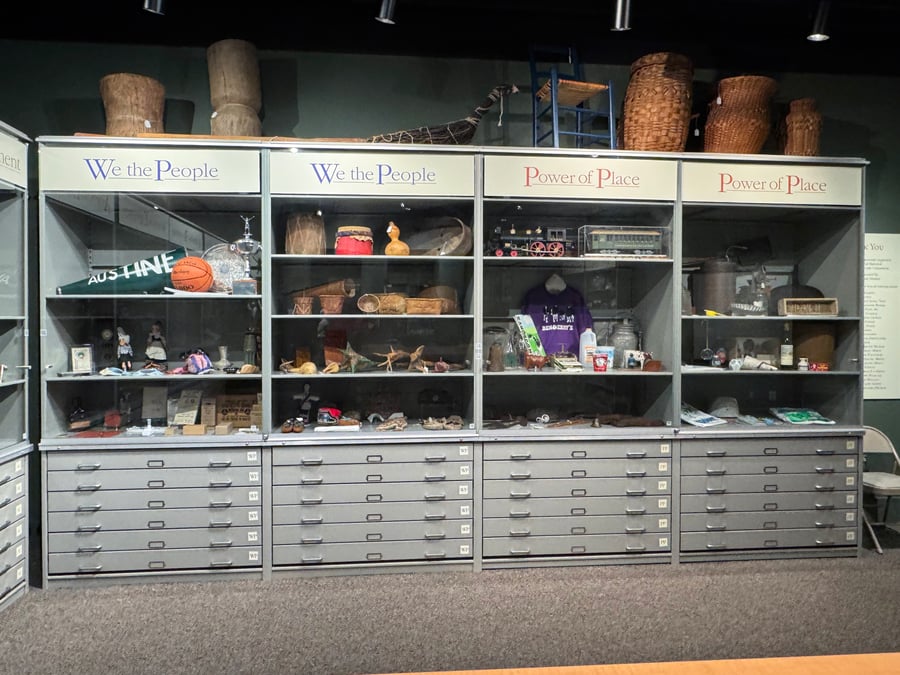
Museum-grade cabinets drawers and with glass front allow visitors to view stored collections while maintaining preservation standards.
How Storage as Display Makes Better Use of Space
Traditional museum layouts separate exhibition space from storage space. Galleries are designed for the public; storage rooms are designed for staff. That division means your building dedicates significant square footage to areas visitors never see, and it limits how much of your collection you can share.
Storage as display collapses that divide. When cabinets and shelving systems serve both preservation and exhibition functions, you recover floor space that would otherwise serve only one purpose. A single row of museum-grade preservation cabinets with glass doors can combine storage and viewing functions, depending on object size, access needs, and conservation requirements.
For institutions managing growing collections in historic buildings, this dual-purpose approach is transformative. You increase the volume of objects on view without adding square footage and reduce the handling required to rotate items between storage and exhibition.
Visible Storage Solutions for Museums and Historical Societies
No single system addresses every collection type. Textiles, framed artworks, small artifacts, and oversized objects each demand different storage configurations. The following five solutions represent practical approaches to visible storage, each designed to balance public access with preservation requirements.
Secure Drawer Cabinets with Glass Display Tops
Drawer cabinets with glass tops are among the most versatile visible storage configurations for small to mid-sized artifacts. A glazed top can enclose a display compartment above organized drawers. Other designs place protective glass covers over individual trays so selected objects remain visible when a drawer is opened.
What makes this configuration effective is the distinction between public and staff access. The drawers can be configured with individual locks, so curators control access. Public-operated drawers require a purpose-designed system; a staff-only drawer should remain under staff control, even when its contents can be viewed through glass.
The Vermont Historical Society worked with Donnegan Systems to implement Spacesaver 4-Post shelving with Nantucket drawers featuring glass tops and individual locks. The drawers secured framed art, quilts, and tapestries. Half-height locking doors above the drawers protected objects on open shelving above.
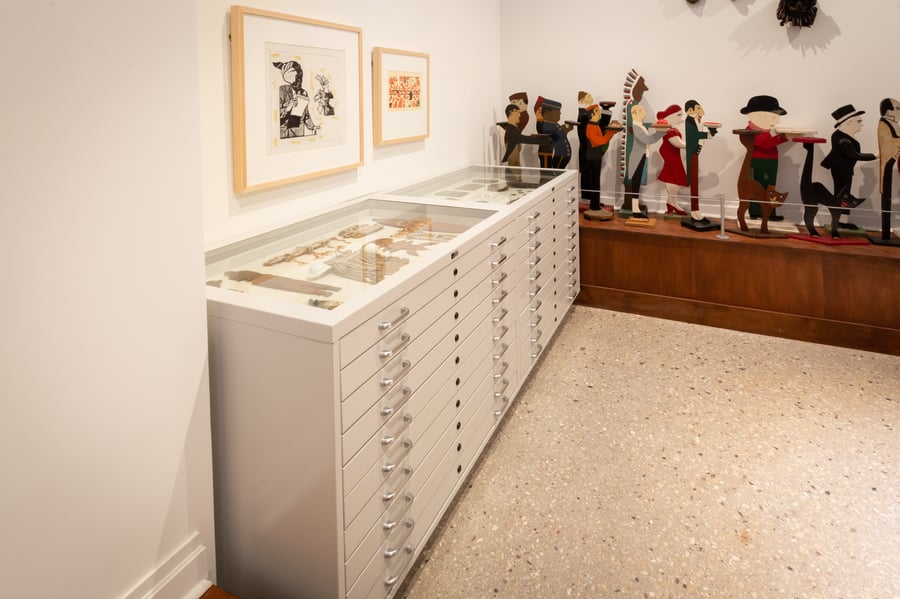
Nantucket drawers with glass tops provide both secure storage and visible display for small artifacts and archival materials.
High-Density Mobile Shelving with Display End Panels
High-Density Mobile Shelving eliminates fixed aisles by mounting shelving on carriages that move along floor-mounted rails. Depending on the layout, this mechanism can increase your storage capacity by compacting rows and opening aisles only where access is needed.
When combined with custom display end panels, these systems become visible storage solutions. The first carriage facing a gallery can feature glass panels, custom graphics, or display shelves, giving visitors a curated view of the collection.
Donnegan Systems designs High-Density Mobile Shelving configurations that integrate display features with preservation-grade storage for institutions of every size across New England and Eastern New York.
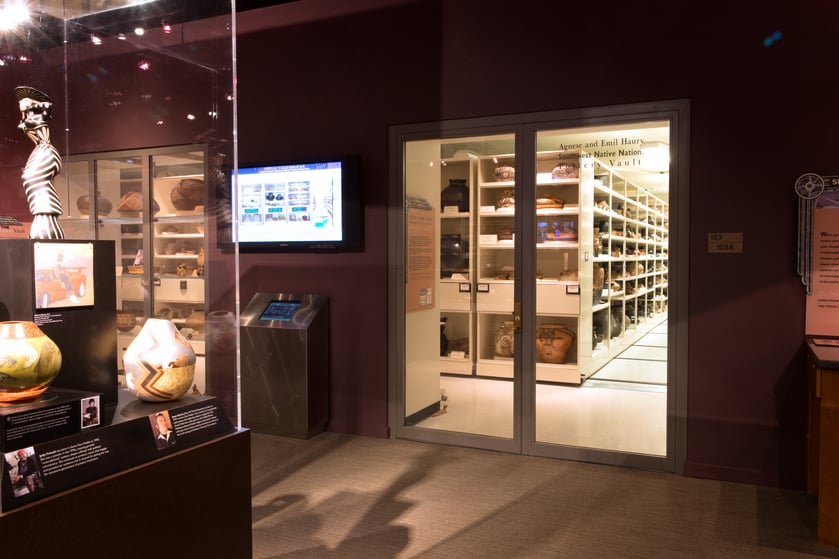
High-Density Mobile Shelving with display end panels allows museums to showcase select artifacts while maximizing back-of-house storage capacity.
Collection Storage Behind Glass Doors and Walls
Glass walls and glass-doored shelving create a window into the collections care process, allowing visitors to watch curators at work. This approach transforms a storage area into an exhibit, letting the public observe how artifacts are handled and preserved.
Place High-Density Mobile Shelving and a collections work area behind a glazed partition to provide a controlled viewing opportunity. Curators can select outward-facing displays and demonstrate cataloging or object preparation during scheduled sessions. Keep mobile-system controls and handling areas restricted to authorized staff.
For historical societies in New England, this model works well in renovated spaces where a former office can become a glass-walled visible storage gallery, provided the room meets structural, environmental, accessibility, and collection-care requirements.
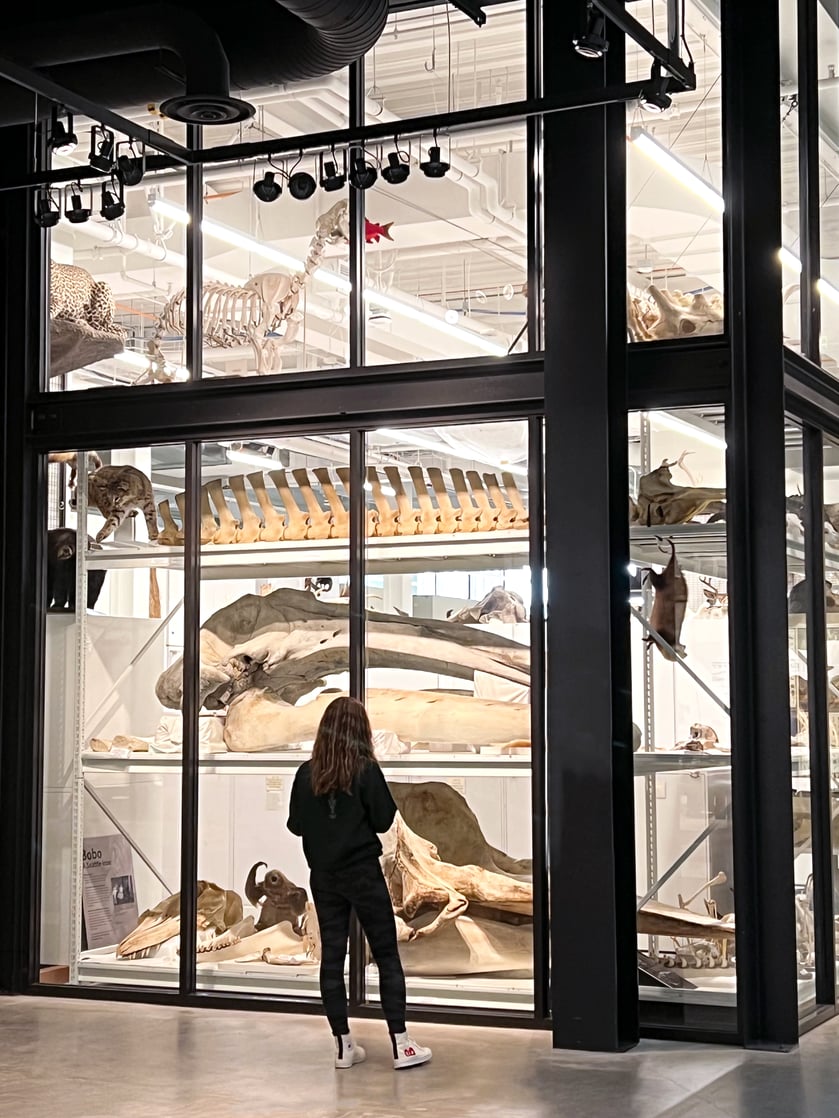
Glass-enclosed storage areas let visitors observe selected objects from a museum's collection and the care that goes into preserving it.
Glass Cabinets with Adjustable Display Shelves
For institutions that need flexibility as collections grow and exhibitions rotate, glass-fronted museum cabinets with adjustable interiors offer a proven solution. Spacesaver's Preservation Cabinets feature UV-protected tempered glass panels, non-off-gassing powder coats, and reconfigurable interiors with adjustable trays, dividers, and shelving.
Appropriately specified cabinets help manage dust, pests, and handling risks while keeping selected objects visible. No cabinet alone eliminates all deterioration risks; match seals, glazing, materials, and environmental management to the objects being stored. Counter-height models double as work surfaces or display cases. Full-height models serve as freestanding visible storage elements in lobbies or collections galleries.
The modular design means you can reconfigure the interior as your collection changes without replacing the cabinet itself. Add or remove shelves, trays, and dividers as needed. This adaptability makes these cabinets a sound long-term investment for institutions with evolving collections.

The 920 Series Preservation Cabinet combines enclosed storage with glass-front visibility, making it a versatile choice for visible storage.
Pull-Out Art Racks for Galleries and Museum Collections
Paintings, prints, and framed photographs present a unique storage challenge. Stacking or leaning framed pieces risks damage, and traditional flat storage consumes large amounts of floor space. Pull-out art rack systems solve both problems by suspending works vertically on sliding panels.
Donnegan Systems offers six art rack configurations: modular freestanding, wall-mounted, lateral, carriage-mounted, floor-supported, and overhead-supported Hang-Glider Pro systems. Each minimizes vibration, protecting delicate works.
In a visible storage setting, art racks placed in a gallery or behind a glass partition bring selected framed works into public view. Staff can pull out panels during tours for an interactive experience beyond what a static gallery wall provides.

Pull-out art racks let visitors and staff view selected framed works stored compactly on sliding panels.
How to Plan for Preservation, Security, and Visitor Access
Planning visible storage requires managing light, environmental conditions, handling risks, and visitor circulation. Planning for these factors from the outset is essential.
Light and environmental controls: UV-filtering glass, LED lighting with adjustable intensity, and strategic placement away from windows help manage exposure. Monitor temperature and relative humidity, and plan rotations for light-sensitive textiles, works on paper, and photographs. Glazing specifications do not eliminate cumulative light exposure.
Security and access control: Locking mechanisms on drawers, cabinets, and mobile shelving carriages let you control who interacts with stored objects. Programmable access controls on powered systems add additional protection.
Safe workflows for staff: Clear handling protocols, designated access times, and traffic flow that separates staff from visitors help your space function well for everyone. Include accessible viewing heights, circulation clearances, and readable labels.
Glass alone does not provide climate control or suitable light protection. Include environmental monitoring and collection-specific light limits in your museum space planning. For collections with strict requirements, visible storage should be located within climate-controlled zones or paired with preservation-grade HVAC.
Planning Visible Storage in New England and New York
Every visible storage project starts with understanding your space, collection, and goals. What objects do you want the public to see? How much floor space can you dedicate? What environmental conditions does your building provide?
Donnegan Systems has been helping museums, galleries, and historical societies across New England and Eastern New York answer these questions through customized space planning. The process starts with a free on-site survey to assess your facility and collection.
With more than 100 manufacturer partners and a manufacturer-trained installation team, Donnegan Systems delivers full-service support from planning through installation. The service department remains available to maintain, adjust, or expand your systems as needs change.
If your institution is considering visible storage, request a free site survey to start the conversation. A Donnegan storage expert can help you evaluate your space and develop a plan that brings more of your collection into public view.
FAQs About Museum Visible Storage
What is museum visible storage?
Museum visible storage is a collections management approach that places stored objects where the public can view them, typically using glass-fronted cabinets, open shelving, or transparent barriers. This strategy lets institutions display more of their collection without additional exhibition space and supports public engagement by making preservation transparent.
Does visible storage compromise artifact preservation?
Visible storage must be planned around the preservation needs of each object. Glazing, seals, lighting, and environmental monitoring all require consideration. Donnegan Systems helps you select storage configurations, while your collections-care team establishes appropriate exposure limits, handling rules, and environmental requirements.
What types of collections work with visible storage?
Visible storage accommodates a wide range of collection types. Drawer cabinets with glass tops work for small artifacts and specimens. Art racks serve paintings, prints, and framed works. High-Density Mobile Shelving with display end panels handles larger collections. Donnegan Systems helps institutions match each collection type to the right configuration.
How does visible storage save space in museums?
Visible storage combines exhibition and storage functions into the same footprint. Instead of maintaining separate gallery space and back-of-house storage, institutions use dual-purpose systems that display objects while preserving them. High-Density Mobile Shelving further increases capacity by eliminating fixed aisles, with capacity gains determined by the layout and collection requirements.
Can Donnegan Systems help plan visible storage for a small historical society?
Donnegan Systems works with institutions of every size, from large research museums to small historical societies. The planning process starts with a free on-site survey to assess your space, collection, and goals. Our team of storage experts creates a customized plan that fits your budget, with options to expand as your collection grows.


